
Abatement Technologies Air Duct Cleaning in Charlotte: A Homeowner’s Guide
The machine pulling air through your ducts during a cleaning job decides whether contaminants get captured or just pushed back into the rooms you live in. Most homeowners never think to ask what equipment is on the truck. They ask about price, then watch a van pull away wondering what actually happened upstairs. If you’d rather not gamble on a blower and a hose, call (833) 962-6967 for a free estimate.
Abatement Technologies equipment was engineered for disaster restoration and asbestos abatement work. When that same grade of machine is used for residential duct cleaning in Charlotte, it brings negative pressure and HEPA filtration that ordinary budget setups don’t come close to.
What Is Abatement Technologies Equipment, and Why Does Its Origin Matter?
Abatement Technologies builds HEPA filtration and negative-air machines for restoration contractors, not for the residential duct cleaning market. That origin is the whole point. Equipment designed for post-fire and post-flood cleanup has to hold up under heavy particulate loads and keep contaminated air from escaping into clean spaces. A contractor cleaning up after a fire can’t afford to spread soot through a house. The same standard applies to your duct system.
Here’s what that means in practice for a Charlotte home:
- Sealed capture: the machine connects to the duct system and filters the exhaust air rather than venting dust into a bedroom or hallway.
- Continuous negative pressure: the system stays under suction for the duration of the job, so loosened debris travels toward the capture point instead of settling back on duct walls.
- HEPA-grade final filtration: fine particulate that standard shop vacuums release back into the air is trapped instead of recirculated.
When a discount service runs a blower without proper filtration, the dust has to go somewhere. Usually that’s your living room. Equipment built for remediation work closes that gap. That’s the difference homeowners in Charlotte are paying for when they choose an equipment-serious cleaner.
What Does HEPA Filtration Actually Capture?
HEPA filtration captures particles down to 0.3 microns at a high efficiency rate, which covers the fine dust, pollen, pet dander, and mold spores that standard vacuums miss. That gap matters most in homes where someone has allergies or asthma. Those are the particles small enough to stay airborne and reach deep into the lungs.
Consider what a typical residential system holds. Fans, returns, and supply runs accumulate a mix of settled dust, hair, pet fur, construction debris from any past renovation, and whatever the HVAC filter didn’t catch. A shop-vac-style cleaner picks up the visible layer and stirs the rest. An uncaptured cloud of fine particulate drifts out of the registers and settles again over the following days. You may notice more dust right after a cheap cleaning than before it, and that isn’t your imagination.
Nikro HEPA vacuums, which we use alongside our Abatement Technologies equipment, address exactly this problem. They’re rated to hold the fine fraction rather than exhaust it. In a Charlotte home with a toddler crawling on the floor or a dog that sheds year-round, that difference is the reason to care about equipment grade.
What Does Negative-Pressure Source Removal Look Like Step by Step?
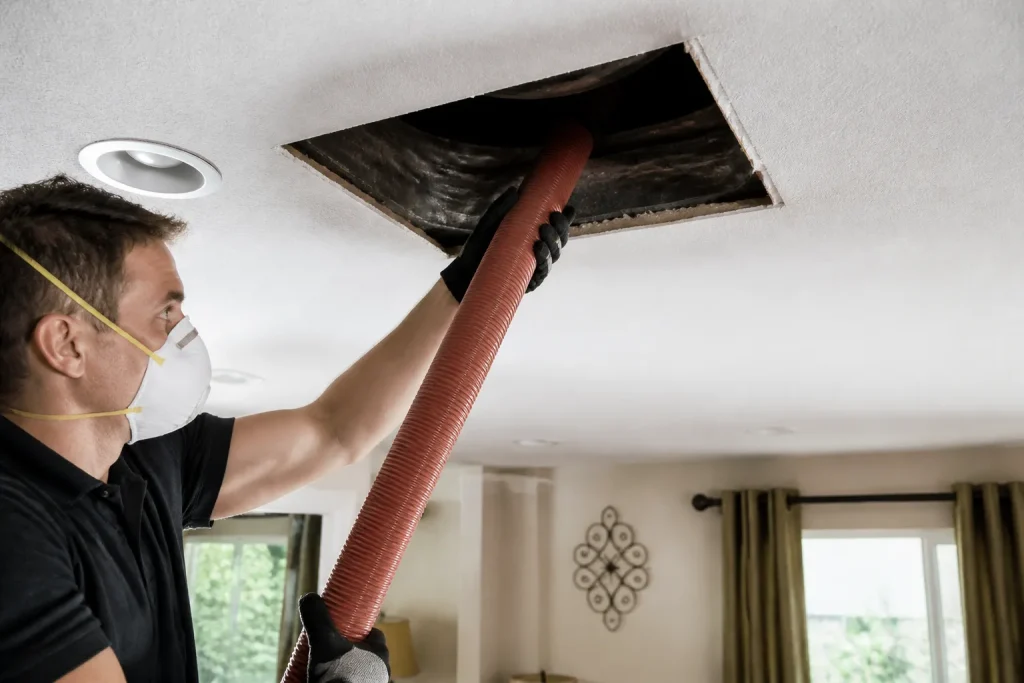
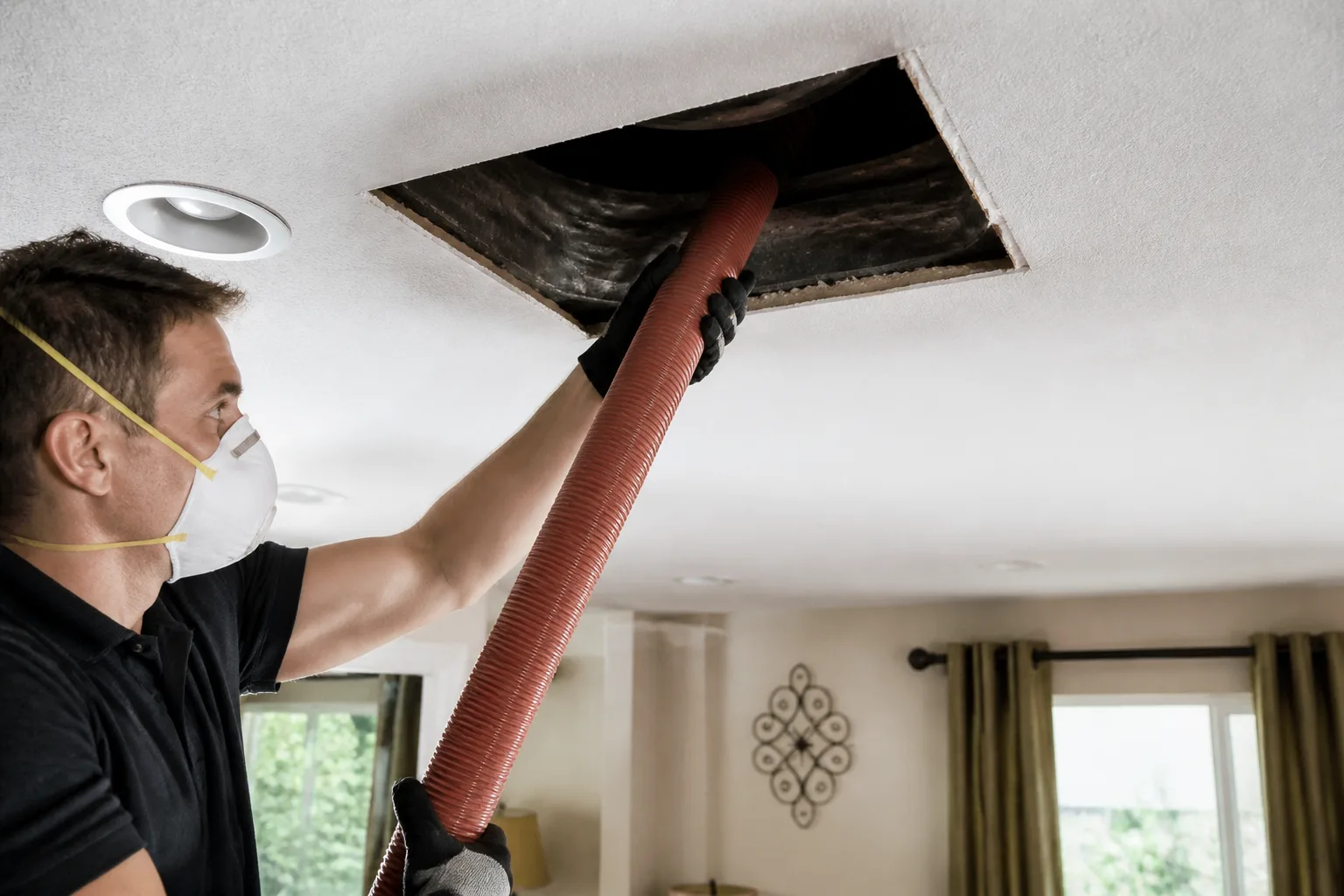
Negative-pressure source removal means the duct system is put under suction before any agitation begins, so loosened debris moves toward the capture point rather than into the room. Here’s the sequence in plain terms:
- 1
Inspection and access. We open access points at the air handler, main trunk, and selected branch runs so the full system can be reached.
- 2
Connect and pressurize. The HEPA unit connects to the system, and negative pressure is established. Everything inside now moves one direction: out.
- 3
Contact cleaning. A Rotobrush rotary brush travels the duct interiors, scrubbing the walls where dust binds. This is contact cleaning, not a blast of compressed air.
- 4
HEPA extraction. Captured material pulls through the Nikro HEPA vacuum and the Abatement unit’s filtration before any air is released.
- 5
Finishing and verification. Guardsman products treat surfaces and components after extraction. We photograph before-and-after conditions inside your own ducts so you see what changed.
That’s what “source removal” really means. Blower-only approaches skip steps two, three, and four. It’s the difference between cleaning a system and aerating it. When we put together a plan for air duct cleaning across the region, the process above is the standard we hold to.
How Do Abatement Technologies, Rotobrush, and Nikro Work Together?
Each piece of equipment in our toolkit serves a distinct function, and none of them substitutes for the others. Abatement Technologies handles containment and filtration. Rotobrush handles contact cleaning. Nikro handles fine-particulate extraction at the vacuum. Used together, they cover the whole job.
Think of it as a system rather than a single tool:
- Abatement Technologies: negative pressure and HEPA-grade containment, the piece that keeps contamination from spreading through the house.
- Rotobrush: the rotary contact-cleaning head that reaches duct walls and loosens what’s stuck to them.
- Nikro: HEPA-rated vacuum capture at the extraction end.
- Guardsman: finishing and protection after the cleaning is complete.
Most duct cleaning companies in Charlotte carry one method and one machine. The equipment lineup above exists because different duct conditions call for different handling. A routine cleaning in a well-maintained home and a post-renovation cleanup with drywall dust throughout the system aren’t the same job, and they shouldn’t be treated as if they are. As a full-service duct specialist, we also handle dryer vent cleaning and duct repair in-house, so related problems get resolved by the same team.
Does Equipment Grade Change the Outcome for a Lightly Contaminated System?
Honestly? For a lightly contaminated system, the visible result between a good blower setup and a full HEPA-negative-pressure job may be smaller than you’d expect. Both will pull the loose dust. The difference shows up in what stays in the air afterward, and in homes with allergies or asthma, that’s the part that counts.
Equipment grade matters most in a few specific situations:
- Recent renovation or construction: drywall dust and fine particulate spread through the whole system and require containment to handle safely.
- Water intrusion or musty odors: the possibility of microbial growth means the job needs more than routine dust removal.
- Allergy or asthma sufferers in the household: fine particles that escape a standard vacuum matter more here than anywhere.
- Long intervals between cleanings: heavy accumulation means heavier particulate loads, and heavier loads need real filtration.
For a household with no sensitivities and a system cleaned on a reasonable schedule, the marginal gain from remediation-grade equipment is real but modest. For anyone in the heavier categories above, it changes the job. Which is why we ask questions before we quote rather than selling one package to every home in Charlotte. If your system falls into one of those categories and you’re wondering whether it’s worth addressing, that’s the moment to learn how we approach duct health rather than guess.
When to Call a Pro
If you’re seeing visible dust blowing from registers right after a cleaning, noticing musty odors when the system kicks on, or dealing with a recent renovation that left debris in the returns, those are signs the job needs proper equipment. Call (833) 962-6967. We answer 24/7. Fast dispatch from 7am to 7pm, Sunday through Friday.
Related services in Charlotte: dryer vent cleaning (lint buildup is a leading cause of house fires, and the same team handles it) and air duct cleaning for the full-system process above.
The Bottom Line
Ask what machine is on the truck before you book. That one question tells you more about what you’re paying for than any discount flyer. Abatement Technologies equipment comes from the restoration side of the trade, where keeping contamination contained isn’t optional. Sitting alongside Rotobrush contact cleaning, Nikro HEPA extraction, and a finishing step with Guardsman, it gives a duct cleaning job the equipment it needs to actually remove contaminants rather than redistribute them. That’s the outcome worth paying for in a Charlotte home.
If you’re in Charlotte and need help, Stratford Air Duct Cleaning offers free estimates. Call (833) 962-6967. We’ve served the area since 2017, and we’ll show you before-and-after photos of your own ducts when we’re done.
Frequently Asked Questions
Prices vary by system size and condition, so we quote per job after seeing the system. Call (833) 962-6967 for a free estimate and a written price before any work starts.
Cheaper quotes usually involve a blower-only setup without HEPA filtration or containment, which can redistribute dust rather than capture it. Ask what equipment a company brings before you book, then call (833) 962-6967 for an honest comparison.
Ask for before-and-after photos from inside your own ducts. We take them on every job. Call (833) 962-6967 to schedule and see the difference yourself.
Most homes do fine with cleaning every few years, sooner after major renovation or if anyone in the house has allergies. Call (833) 962-6967 and we’ll help you decide what your system actually needs.
Written by the team at Stratford Air Duct Cleaning, serving Charlotte since 2017.
Need Air Duct Cleaning Help?
Call Stratford Air Duct Cleaning - licensed & insured, with free written estimates in Charlotte.
(833) 962-6967